When businesses evaluate digital communication channels to engage their audience, two options consistently stand out: web push notifications and email marketing. Both give website owners direct access to interested users without relying entirely on search engine visibility or social media algorithms.
However, web push and email are fundamentally different communication channels. Comparing web push notifications vs email marketing is not about finding a single winner. Instead, the right choice depends on your audience, message urgency, content format, and marketing goals.
In this guide, we explore the key differences between browser push alerts and email, examine where each channel excels, highlight practical use cases across ecommerce, SaaS, and publishing, and explain how using both together builds an effective customer engagement strategy.
What Are Web Push Notifications?
Web push notifications are clickable alert messages delivered directly to a user's web browser on desktop computers, tablets, and mobile devices. They appear on the screen in real time, even when the visitor is not actively viewing your website.
Subscribing requires no sign-up forms, passwords, or personal details. Visitors become subscribers with a single click on a browser permission prompt. For a detailed breakdown of how push technology works, read our complete guide to web push notifications.
What Is Email Marketing?
Email marketing is a digital communication strategy where businesses send structured messages directly to a subscriber's inbox. Because email is a universal protocol, it remains a cornerstone of digital marketing and customer relationship management.
To join an email list, users provide their name and email address via a sign-up form. Once subscribed, businesses can send newsletters, product tutorials, transactional receipts, promotional campaigns, and automated welcome sequences. Email supports extensive formatting, custom HTML designs, and rich media.
Web Push Notifications vs Email Marketing: Key Differences
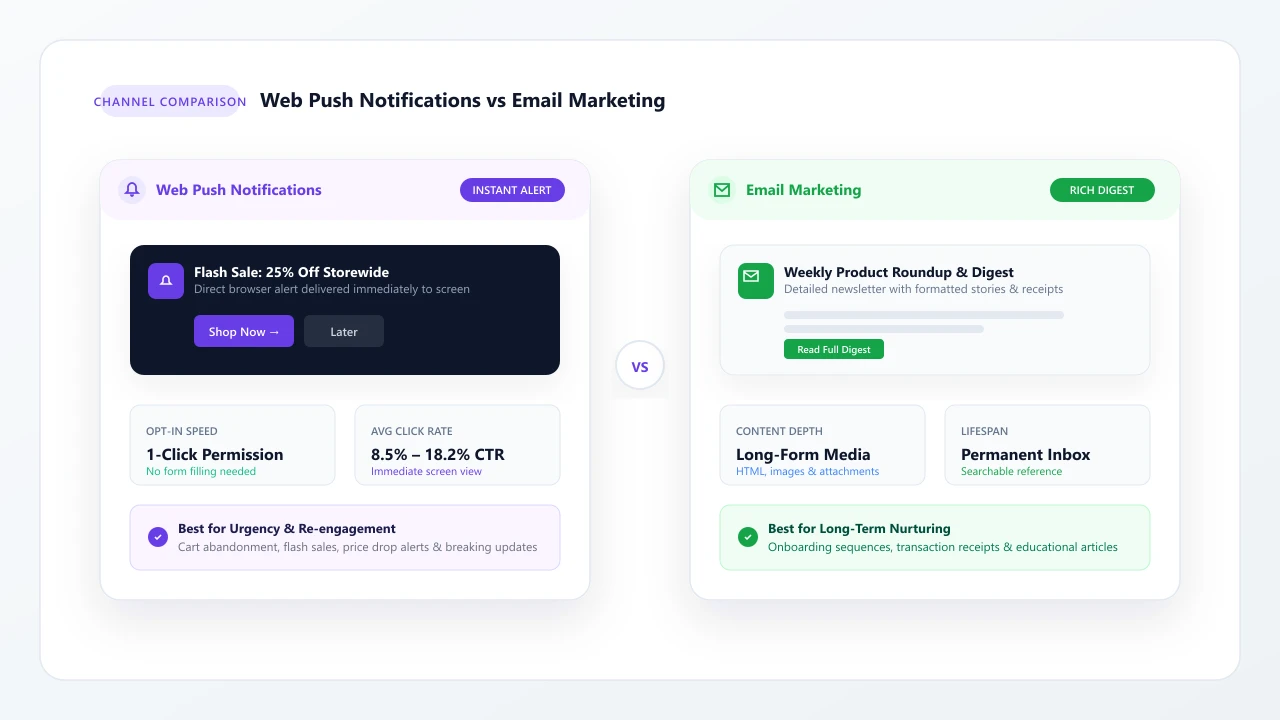
To compare web push vs email clearly, the table below highlights how both channels operate across key performance and operational areas:
| Feature | Web Push Notifications | Email Marketing |
|---|---|---|
| Delivery | Instant on-screen alert | Delivered to inbox |
| Permission | 1-Click browser prompt (anonymous) | Form submission (requires email address) |
| Message Length | Short (headline + 1-2 sentence description) | Unlimited (long-form text + rich media) |
| Inbox Dependency | None (bypasses spam and promo tabs) | High (subject to spam and promo filtering) |
| User Attention | Immediate visual visibility on screen | Requires user to open inbox |
| Personalization | Dynamic tags, device, and behavior | Merge tags, purchase history, and demographics |
| Automation | RSS triggers, welcome drips, cart alerts | Multi-step drip campaigns, onboarding |
| Segmentation | Geo, OS, browser, viewed pages, tags | List segments, purchase history, activity |
| Content Format | Title, body, icon, banner, action buttons | Full HTML templates, images, attachments |
| Best Use Cases | Urgent alerts, flash deals, cart recovery | Newsletters, educational guides, receipts |
| User Retention | Brings visitors back with instant nudges | Builds long-term brand relationship |
| Analytics | Delivery rate, clicks, CTR, conversions | Delivery, open rates, clicks, bounces |
When Should You Use Web Push Notifications?
Web push notifications excel whenever speed, brevity, and immediate action matter most. Because push alerts appear directly on a user's screen without requiring an email client, they generate quick responses.
Key use cases for push notification marketing include:
- Flash Offers: When a sale lasts only 24 hours, web push reaches shoppers instantly.
- New Content: The moment a new blog post goes live, notify readers without waiting for search indexing.
- Price Alerts: When a product drops in price, an automated push alert gives buyers an immediate prompt to buy.
- Time-Sensitive Updates: Urgent service notices, live stream alerts, and webinar reminders.
- Cart Reminders: Nudging a shopper 30 minutes after abandoning a cart brings them back while interest is high.
- Returning Visitors: Bringing past visitors back to your site before they forget your brand.
- Breaking News: Delivering timely news updates to readers within seconds.
When Should You Use Email Marketing?
Email marketing remains the best channel for detailed, high-value, and long-form communication. While push alerts are consumed in seconds, emails are saved, searched, and referenced over time.
Email marketing is ideal for:
- Newsletters: Sharing weekly roundups, curated insights, and editorial commentary.
- Product Updates: Explaining feature releases, version updates, and migration steps with rich formatting.
- Educational Content: Delivering multi-part email courses and structured tutorials.
- Long-Form Communication: Sharing founder stories, case studies, and in-depth analyses.
- Lead Nurturing: Guiding potential buyers through an informative sales sequence.
- Customer Onboarding: Walking new users through account setup checklists over their first two weeks.
- Promotional Campaigns: Presenting catalog lookbooks, seasonal collections, and comprehensive buying guides.
Can You Use Web Push Notifications and Email Together?
Rather than treating these channels as competitors, modern growth teams treat them as complementary components of a unified multichannel marketing strategy.
Relying solely on email means missing visitors who prefer not to share their contact information. Relying solely on web push means lacking a channel for deep educational content and receipts. Combining both channels creates multiple touchpoints that reinforce each other.
For instance, a new visitor might subscribe to web push with 1 click on their first visit. A timely push notification later brings them back to read an in-depth article. Within that article, they find a valuable resource and subscribe to your email list, allowing you to nurture them across both channels.
LumaPush brings web push notifications, email marketing and automation together so businesses can manage multiple customer communication channels from one platform. Instead of managing disconnected tools with separate databases, LumaPush lets you coordinate campaigns, track cross-channel engagement, and build automated workflows from a single dashboard. Learn how email marketing automation works alongside push triggers on our features page.
Web Push vs Email for Ecommerce
In ecommerce, both channels fulfill distinct roles across the customer journey:
- Web Push for Ecommerce: Ideal for recovering abandoned carts within an hour, announcing flash sales, alerting shoppers to back-in-stock items, and broadcasting price drops. Its instant delivery drives quick purchases.
- Email for Ecommerce: Ideal for sending order confirmations, delivery tracking receipts, personalized post-purchase recommendations, and customer review requests.
Using push for immediate urgency and email for relationship-building helps online stores increase repeat orders and customer lifetime value.
Web Push vs Email for SaaS Businesses
Software-as-a-Service companies depend heavily on user activation and ongoing retention:
- Web Push for SaaS: Great for prompt in-browser notifications, alerting users when teammates complete tasks, and sending account renewal reminders.
- Email for SaaS: Essential for step-by-step onboarding sequences, billing receipts, security verification notices, and detailed release notes.
Web Push vs Email for Publishers and Content Websites
For digital publishers, news websites, and bloggers, audience retention drives sustainable growth:
- Web Push for Publishers: Delivers breaking news and new post alerts the moment they are published, generating immediate traffic. Automated RSS campaigns send push alerts automatically.
- Email for Publishers: Houses weekly editorial digests, curated reading lists, sponsor spotlights, and subscriber-only newsletters.
Which One Should You Choose?
When choosing between push notifications vs email marketing, the right choice depends on your specific objective:
- Choose web push notifications when speed, low opt-in friction, and real-time re-engagement matter most. It is ideal for flash sales, breaking news, and fast reminders.
- Choose email marketing when you need to share detailed information, educational content, long-form newsletters, or permanent transactional records.
- Use both channels together when your business wants a comprehensive customer engagement strategy. Combining 1-click push opt-ins with targeted email nurturing creates a reliable marketing engine.
You can explore available plans and features on the LumaPush pricing page.
Frequently Asked Questions
What is the difference between web push and email marketing?
Web push notifications are instant, clickable alert messages delivered directly to a user's browser or device screen without opening an email client. Email marketing delivers longer, formatted messages containing text, images, and attachments directly into a subscriber's email inbox.
Are push notifications better than email?
Neither channel is universally better. Web push notifications excel at immediate urgency, breaking news, and fast re-engagement with minimal opt-in friction. Email marketing excels at long-form education, newsletters, detailed receipts, and rich storytelling.
Can push notifications replace email marketing?
No. Push notifications are not designed to replace email marketing. They serve different communication purposes. The most effective engagement strategies use both channels together in a coordinated multichannel workflow.
Can I use push notifications and email together?
Yes. Combining web push notifications with email marketing allows you to reach subscribers through their preferred channels. For example, you can send time-sensitive flash alerts via web push while sending detailed weekly digests and onboarding sequences via email.
Which is better for ecommerce?
Both are essential for ecommerce. Web push notifications work exceptionally well for time-sensitive cart abandonment reminders, flash sales, and price drop alerts. Email marketing is ideal for order confirmations, post-purchase receipts, and personalized product recommendations.
Which is better for customer retention?
Using both channels together provides the highest customer retention. Web push brings users back to your site instantly with 1-click reminders, while email nurtures long-term loyalty with educational content and deeper account updates.