

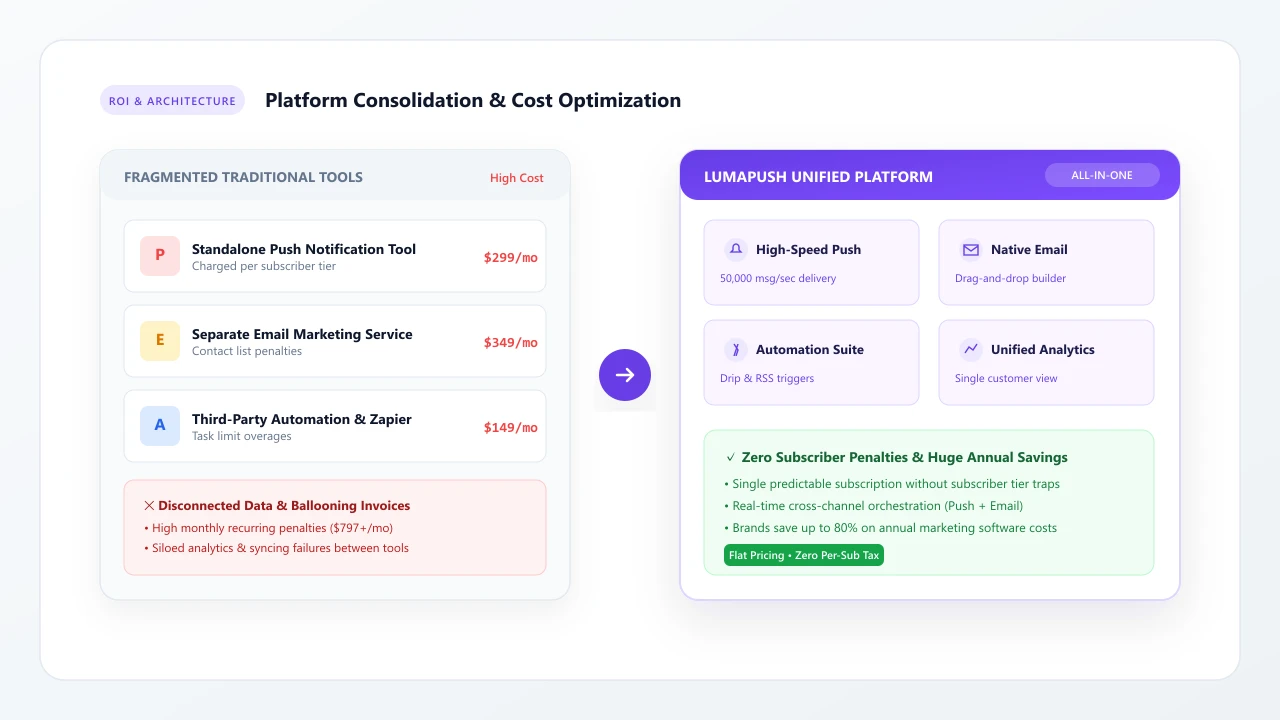
If you have scaled an online store, SaaS application, or content publishing website, you are likely familiar with the frustration of escalating software bills. What starts as an affordable subscription often expands significantly simply because your subscriber list grew.
Many legacy web push services and email marketing platforms rely on per-subscriber pricing tiers. Under this model, businesses pay increasing monthly fees based on the total number of contacts in their database—regardless of how frequently they send messages or how much value those subscribers generate.
This pricing structure penalizes businesses for succeeding. Today, marketing and engineering teams are choosing unified customer engagement platforms like LumaPush to consolidate their marketing stack, eliminate subscriber penalties, and manage push notifications and email from a single interface.
The Financial Impact: Per-Subscriber Fees vs Flat Platform Pricing
To understand why companies switch, let's examine the financial realities of running separate tools for push notifications and email marketing.
Consider a business with 100,000 web push subscribers and a 25,000 email contact list:
| Channel Setup | Legacy Provider Approach | Estimated Monthly Cost | Estimated Annual Cost |
|---|---|---|---|
| Standalone Web Push | Billed per subscriber tier (100k contacts) | $250 – $350 / mo | $3,000 – $4,200 / yr |
| Separate Email Marketing | Billed per contact tier (25k contacts) | $250 – $400 / mo | $3,000 – $4,800 / yr |
| Third-Party Automation | API task limits & zap overages | $50 – $150 / mo | $600 – $1,800 / yr |
| Total Legacy Tool Stack | Fragmented tools, multiple invoices | $550 – $900 / mo | $6,600 – $10,800 / yr |
| LumaPush Unified Platform | Web push + email marketing combined | $29 – $79 / mo | $348 – $948 / yr |
By switching to a unified platform, businesses frequently save between 70% and 85% on annual marketing software expenses while removing the administrative overhead of managing multiple vendor contracts.
Why Managing Fragmented Marketing Tools Fails
Beyond direct software costs, running separate point solutions creates operational friction that hurts marketing performance.
1. Siloed Subscriber Data
When your push subscriber list lives in one tool and your email audience lives in another, you cannot easily understand the complete customer journey. A user might receive an email promotion and an identical push notification at the exact same moment, causing notification fatigue and higher unsubscribe rates.
2. Inconsistent Messaging and Branding
Coordinating multichannel campaigns across different dashboards requires manual synchronization. Setting up an abandoned cart flow across email and push often involves complex third-party webhooks that break whenever API versions change.
3. Team Overhead and Training Costs
Marketing teams must learn different campaign builders, user permission systems, and reporting interfaces. Consolidating into one workflow simplifies campaign execution and reporting.
How LumaPush Combines Push and Email Marketing
LumaPush is a customer engagement platform designed to bring web push notifications, email marketing, and automated workflows into one cohesive dashboard.
Key Architectural Advantages:
- Unified Audience Profiles: Manage push subscribers, email contacts, and behavioral segments from a single central database.
- Cross-Channel Workflows: Coordinate push notifications and emails within automated sequences. For example, send an urgent browser alert for flash discounts, followed by a detailed email digest for comprehensive product guides.
- Visual Drag-and-Drop Builders: Build responsive emails and custom browser prompt modals without writing code.
- Zero Subscriber Penalties: Scale your audience without facing artificial pricing barriers every time you gain 1,000 new subscribers. Check out our straightforward pricing plans.
How to Migrate from Legacy Providers to LumaPush
Migrating to LumaPush is straightforward and requires no downtime:
- Add Your Domain: Add your website in the LumaPush dashboard and copy the lightweight JavaScript SDK snippet into your site header.
- Import Existing Push Subscribers: If you use VAPID keys from an existing push provider, export your subscription data and import it directly into LumaPush.
- Upload Email Contacts: Import your email subscriber lists via CSV with custom tags and attributes.
- Configure Sending Domains: Verify your SPF, DKIM, and DMARC DNS records for optimal email deliverability.
- Launch Automated Workflows: Set up your welcome sequences, RSS triggers, and re-engagement campaigns in the automation studio.
Frequently Asked Questions
Why are businesses migrating from OneSignal and Mailchimp to LumaPush?
Businesses migrate to LumaPush to eliminate steep per-subscriber pricing tiers, unify separate marketing tools into one clean interface, and reduce annual software expenses by up to 80%.
How does LumaPush pricing compare to legacy tools?
Legacy providers charge escalating monthly fees based on total subscriber count regardless of send volume, whereas LumaPush provides predictable subscription tiers with zero contact penalties.
Can I manage both web push and email marketing in one dashboard?
Yes. LumaPush allows growth teams to manage push campaigns, email newsletters, automated drips, and cross-channel analytics from a single unified command center.