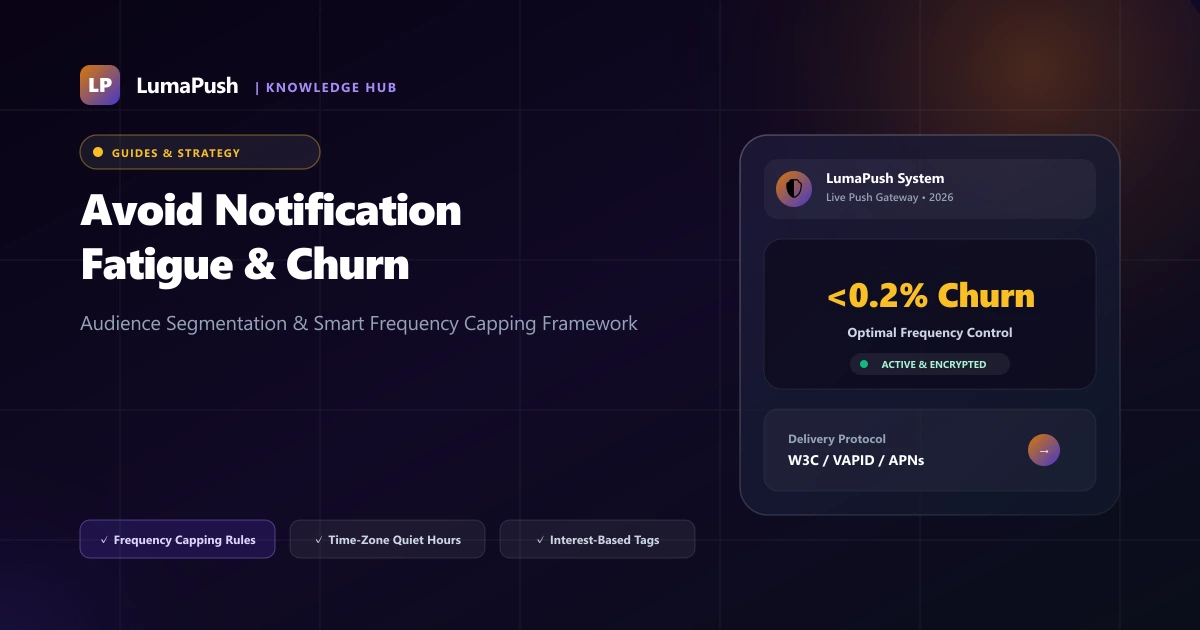
While push notifications provide an unrivaled direct communication line to your audience, over-messaging or sending irrelevant content quickly leads to notification fatigue. When subscribers feel overwhelmed by too many alerts, unsubscribe rates spike, click-through rates decline, and brand trust deteriorates.
High-growth marketing teams and seasoned retention strategists prevent notification fatigue by implementing two essential safeguards: Audience Segmentation and Smart Frequency Capping. In this master guide, we explore data-backed frequency thresholds, time-zone delivery mechanics, and actionable segmentation frameworks for 2026.
Strategies to Prevent Notification Fatigue
- Set Hard Frequency Caps: Limit broadcast volume to a maximum of 1 to 2 notifications per user per day, or 3 to 4 per week for marketing offers.
- Segment by Browsing Behavior: Rather than sending all broadcasts to your entire list, target users based on specific category pages they visited in the last 14 days.
- Honor Subscriber Time Zones: Always schedule campaigns according to the subscriber's local time zone to avoid sending alerts during sleeping hours (10 PM – 8 AM).
- Categorize Content Preferences: Give subscribers control over what topics they want to receive (e.g. Flash Sales vs Weekly Tech Newsletters).
Optimal Sending Frequency by Vertical
| Industry / Vertical | Optimal Weekly Volume | Best Send Window | Fatigue Threshold |
|---|---|---|---|
| Ecommerce & Retail | 2 to 4 campaigns / week | 11:00 AM – 2:00 PM / 7:00 PM – 9:00 PM | > 5 per week |
| News & Media Publications | 1 to 3 alerts / day (Breaking) | Real-time / 8:00 AM & 5:00 PM Digests | > 6 per day |
| SaaS & Digital Products | 1 to 2 campaigns / week | Tuesday – Thursday 10:00 AM – 1:00 PM | > 3 per week |
| Financial Services & Crypto | Real-time price & trade triggers | Market open & close / Volatility spikes | Unsolicited spam promos |
Audience Segmentation: The Secret to High Retention
Broadcast blasts sent to 100% of your subscriber base inevitably experience high unsubscribe rates because not every user is interested in every product or topic. By segmenting your audience into focused sub-audiences, you can deliver hyper-relevant messages that boost click-through rates by up to 180%:
- Recency Segmentation: Target subscribers who joined in the last 7 days with onboarding sequences vs subscribers active in the last 90 days.
- Device OS Targeting: Send macOS/iOS specific announcements to Apple users and Android updates to Google users.
- Behavioral Purchase History: Trigger special VIP discounts exclusively to customers who have spent over $100.
- Category Interest Tags: Segment shoppers interested in Menswear vs Womenswear, or Tech vs Lifestyle.
Discover optimal send timing in our Opt-in Prompt Best Practices and explore automated drip sequencing in our Automation Playbook.
Implementing Preference Centers for Self-Selected Topics
Instead of guessing what your subscribers want, empower them with an on-site Notification Preference Center. By allowing subscribers to toggle specific interest channels (e.g. "Flash Deals", "New Blog Posts", "Weekly Roundup"), you build trust and virtually eliminate involuntary unsubscriptions.
Intelligent Time-Zone Dispatching: No Midnight Alerts
A subscriber receiving a promotional ping at 3:00 AM is almost guaranteed to click Block immediately. LumaPush features automated local time-zone routing: when you schedule a broadcast for 11:00 AM, our dispatch engine calculates each subscriber's local offset and releases the notification when the clock strikes 11:00 AM in New York, London, Tokyo, and Sydney.
Behavioral Churn Predictors: Identifying At-Risk Subscribers
Subscribers do not unsubscribe at random. They exhibit clear behavioral warning signs before clicking Block in their browser settings:
- Click Inactivity: A subscriber who clicked 4 notifications in Month 1 but has clicked 0 in the last 30 days is showing signs of fatigue.
- High Notification Dismissals: Swiping away 5 consecutive notifications without opening signals declining interest.
- Frequency Re-calibration: When fatigue signals are detected, LumaPush's Smart Frequency Throttling automatically reduces sending cadence from 3x/week to 1x/week, preventing permanent unsubscribes.
Implementing Redis Sliding-Window Rate Limiting
To prevent over-messaging across multiple automated drip campaigns and marketing broadcasts, enterprise push engines use sliding window rate limiters in Redis:
// Node.js & Redis Rate Limiter: Max 2 Notifications Per 24 Hours
async function canSendPush(subscriberId) {
  const key = `push_rate_limit:${subscriberId}`;
  const now = Date.now();
  const windowMs = 24 * 60 * 60 * 1000; // 24 hours

  // Remove timestamps older than 24 hours
  await redis.zremrangebyscore(key, 0, now - windowMs);

  // Count alerts sent in the current window
  const count = await redis.zcard(key);
  if (count >= 2) {
    return false; // Frequency cap reached
  }

  // Record this send
  await redis.zadd(key, now, now.toString());
  await redis.expire(key, 86400);
  return true;
}
Timezone-Aware Scheduling & Do-Not-Disturb Quiet Hours
Sending a promotional broadcast at 3:00 AM local time is the single fastest way to trigger high unsubscribe spikes. LumaPush automatically maps each subscriber's IP address and browser locale to their exact IANA timezone (e.g. America/New_York, Europe/London, Asia/Tokyo). Broadcasts are scheduled to deliver during the recipient's optimal local window (typically 10:00 AM to 7:00 PM local time).
Audience Lifecycle Segmentation: Onboarding vs Active vs At-Risk
Different user cohorts have vastly different message tolerances. A brand-new subscriber who opted in 48 hours ago has high brand affinity and is receptive to a 3-part onboarding drip sequence. Conversely, a subscriber who has not visited your site in 60 days will perceive frequent notifications as spam. Segment your audience into lifecycle cohorts and apply distinct frequency rules to each group.
Building a Subscriber Preference Center
Instead of forcing users to choose between all notifications or complete unsubscription, empower your audience with granular preference controls. A modern push preference widget lets visitors toggle specific alert channels (Flash Sales, Product Announcements, Weekly Digest, Breaking News) and adjust frequency limits directly from their account profile page.
Automated Sunset Policies for Dormant Subscribers
Continuing to send messages to subscribers who have not interacted with any push notification in over 90 days damages domain reputation and lowers average CTR benchmarks. LumaPush includes an automated sunsetting engine that automatically pauses marketing dispatches to dormant tokens while reserving high-urgency transactional notices.
Frequently Asked Questions (FAQ)
What is the ideal sending frequency for web push notifications?
For ecommerce stores, 2 to 4 targeted campaigns per week is the industry benchmark. For news publishers and media sites, 1 to 3 breaking news alerts per day is standard, provided content is time-sensitive and relevant.
How does frequency capping work in LumaPush?
LumaPush allows you to configure global frequency rules (e.g. "Do not send more than 1 notification every 24 hours to any individual subscriber"), automatically filtering eligible recipients.
What is the best time of day to send web push notifications?
Across ecommerce and B2B platforms, the highest engagement rates occur between 10:00 AM and 2:00 PM, and in the evening between 7:00 PM and 9:00 PM in the subscriber's local time zone.
How do I reduce push notification unsubscribe rates?
You can reduce churn by implementing behavioral segmentation, avoiding sleep-hour sends, offering category preferences, and using rich push media. For details, read our Rich Push Guide.
Can users select which notification categories they want?
Yes. LumaPush supports topic preference centers where users can toggle notifications for specific categories like Discounts, News, or Product Updates.
What is the average unsubscribe rate for web push?
Industry-wide average unsubscribe rates range between 0.10% and 0.25% per broadcast. Maintaining smart frequency limits keeps churn under 0.10%.
How do I re-engage dormant push subscribers?
Create an automated win-back trigger targeting subscribers with zero site visits in 45 days, offering a personalized welcome-back perk or curated digest.